Japanese Grammar for Absolute Beginners: Part 9 1. ~そうだ (It looks like / I heard that) Meaning: Looks like / seems (appearance) I heard that (hearsay) Structure: [Verb stem] + そうだ (seems like) [い-adjective (remove い)] + そうだ[な-adjective] + そうだ[Sentence plain form] + そうだ (hearsay) Usage Tip: Be careful: 雨が降りそうだ …

Read More »Grammar
Japanese Grammar for Absolute Beginners: Part 8
Japanese Grammar for Absolute Beginners: Part 8 1. 〜てあげる/〜てもらう/〜てくれる Meaning & Explanation: These expressions are used to describe giving or receiving acts of kindness (actions, not things). 〜てあげる = “do something for someone” (speaker or someone gives a favor) 〜てくれる = “someone does something for me/us” (speaker receives a favor) …
Read More »Japanese Grammar for Absolute Beginners: Part 7
Japanese Grammar for Absolute Beginners: Part 7 1. ~し Meaning: Not only… but also; and what’s more Structure: Verb (plain form) + し い-adjective + し な-adjective + だし Noun + だし Usage Tips: Used to list multiple reasons or characteristics. Often ends with a conclusion or emphasis. Examples: このレストランは安いし、美味しいです。 …
Read More »Japanese Grammar for Absolute Beginners: Part 6
Japanese Grammar for Absolute Beginners: Part 6 1. ~に対して(にたいして) Meaning: “Toward” or “against” (used to express direction, opposition, or contrast). Structure: Noun + に対して Explanation: Used to express a direction of action, target, or contrast between two things or people. Usage tips: It can be used for actions, feelings, or …
Read More »Japanese Grammar for Absolute Beginners: Part 5
Japanese Grammar for Absolute Beginners: Part 5 1. ~まだ~ていません Meaning: Not yet… Explanation: Used to express that an action has not been completed yet. Structure: まだ + Verb (て-form) + いません Usage Tips: – まだ emphasizes “still / not yet” feeling. – Often used to show an ongoing expectation that …
Read More »Japanese Grammar for Absolute Beginners: Part 4
Japanese Grammar for Absolute Beginners: Part 4 1. ~でしょう/~だろう Meaning: Probably; I suppose; I think Explanation: Used to express a guess, prediction, or assumption based on some information. ~でしょう is polite, ~だろう is casual. Structure: Verb / い-adjective / な-adjective / Noun + でしょう/だろう Usage Tips: – Use ~でしょう in …
Read More »Japanese Grammar for Absolute Beginners: Part 3
Japanese Grammar for Absolute Beginners: Part 3 1. までに (made ni) Meaning: by (a deadline) Structure: [Time] + までに + [Action] Usage Tip: Deadline or due time. Example: 午後5時までに帰ってください。 (ごご ごじ までに かえって ください) Please come home by 5 PM. 2. ほど (hodo) Meaning: to the extent of, as …
Read More »Japanese Grammar for Absolute Beginners: Part 2
Japanese Grammar for Absolute Beginners: Part 2 1. と (to) Meaning: and, with, quoting, conditional (if/when) Structure: Noun + と + Noun (A and B) Noun + と + Verb (do something with someone) Phrase + と + 思う (I think that…) Usage Tips: – Use と to list all …
Read More »Japanese Grammar for Absolute Beginners: Part 1
Japanese Grammar for Absolute Beginners: Part 1 1. ~です (desu) Simple Explanation: Used to end a sentence politely. It’s like saying “is / am / are” in English. Example: これはペンです。 (kore wa pen desu) This is a pen. Usage Tip: – Use です at the end of a sentence to …
Read More »Master the Japanese Te-Form
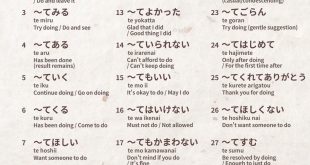
Master the Japanese て-Form The て-form (〜て形) is one of the most important grammar patterns in Japanese. Once you know it, you can express requests, ongoing actions, permissions, sequences, and so much more! Save this cheat sheet and come back whenever you need a quick grammar refresher. Question: Which て-form …
Read More »
Learn Japanese Free Learn Japanese Free