Japanese Grammar for Absolute Beginners: Part 5 1. ~まだ~ていません Meaning: Not yet… Explanation: Used to express that an action has not been completed yet. Structure: まだ + Verb (て-form) + いません Usage Tips: – まだ emphasizes “still / not yet” feeling. – Often used to show an ongoing expectation that …

Read More »Grammar
Japanese Grammar for Absolute Beginners: Part 4
Japanese Grammar for Absolute Beginners: Part 4 1. ~でしょう/~だろう Meaning: Probably; I suppose; I think Explanation: Used to express a guess, prediction, or assumption based on some information. ~でしょう is polite, ~だろう is casual. Structure: Verb / い-adjective / な-adjective / Noun + でしょう/だろう Usage Tips: – Use ~でしょう in …
Read More »Japanese Grammar for Absolute Beginners: Part 3
Japanese Grammar for Absolute Beginners: Part 3 1. までに (made ni) Meaning: by (a deadline) Structure: [Time] + までに + [Action] Usage Tip: Deadline or due time. Example: 午後5時までに帰ってください。 (ごご ごじ までに かえって ください) Please come home by 5 PM. 2. ほど (hodo) Meaning: to the extent of, as …
Read More »Japanese Grammar for Absolute Beginners: Part 2
Japanese Grammar for Absolute Beginners: Part 2 1. と (to) Meaning: and, with, quoting, conditional (if/when) Structure: Noun + と + Noun (A and B) Noun + と + Verb (do something with someone) Phrase + と + 思う (I think that…) Usage Tips: – Use と to list all …
Read More »Japanese Grammar for Absolute Beginners: Part 1
Japanese Grammar for Absolute Beginners: Part 1 1. ~です (desu) Simple Explanation: Used to end a sentence politely. It’s like saying “is / am / are” in English. Example: これはペンです。 (kore wa pen desu) This is a pen. Usage Tip: – Use です at the end of a sentence to …
Read More »Master the Japanese Te-Form
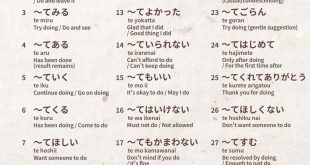
Master the Japanese て-Form The て-form (〜て形) is one of the most important grammar patterns in Japanese. Once you know it, you can express requests, ongoing actions, permissions, sequences, and so much more! Save this cheat sheet and come back whenever you need a quick grammar refresher. Question: Which て-form …
Read More »Examples of Requests and Favors in Japanese
Examples of Requests and Favors in Japanese – – – – – – – Related Post: Practical Grammar for JLPT N5-N4 Learn Basic Japanese Grammar
Read More »Practical Grammar for JLPT N5-N4
Practical Grammar for JLPT N5-N4 100 Practical Japanese Grammar Points for JLPT N5–N4 No Grammar Grammar Meaning Example Example Meaning 1 ~は~です Affirmative: … is … わたしは学生です。 I am a student. 2 ~は~じゃありません Negative: … is not … わたしは医者じゃありません。 I am not a doctor. 3 ~は~ですか Interrogative: Is …? あなたはミラさんですか。 …
Read More »9 Essential “Drop-ます” Patterns in Everyday Japanese
9 Essential “Drop-ます” Patterns in Everyday Japanese 9 Must-Know ‘Drop ます’ Patterns for Everyday Japanese Related Post: Japanese Verbs te form (てform) Learn Basic Japanese Grammar
Read More »JLPT N5-N4 Study Roadmap
JLPT N5-N4 Study Roadmap Basic Japanese language (JLPT N4/N5) GRAMMAR… Related Post: Genki Grammar – Japanese Basic Japanese Grammar
Read More »
Learn Japanese Free Learn Japanese Free