Learn Japanese Free Learn Japanese Free
How to Say “Go,” “Come,” and “Return” in Japanese
The pattern
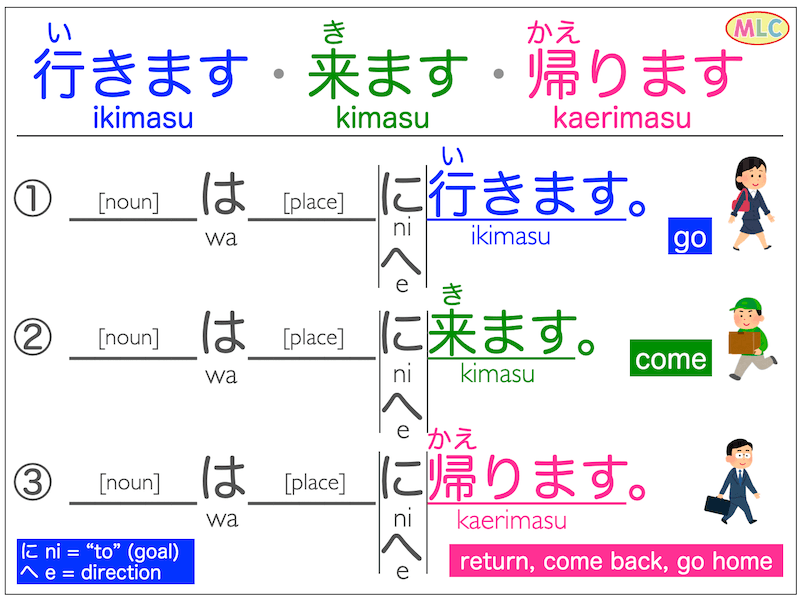
[noun] は [place] に/へ ___ます。
は (wa) — marks the topic (the person doing the action)
に (ni) or へ (e) — marks the destination (“to”)
The slide notes に specifically = “to” (goal), while へ emphasizes direction
The three examples
1. 行きます(いきます / ikimasu)— “go”
2. 来ます(きます / kimasu)— “come”
[noun]は[place]に来ます。— “[Someone] comes to [place].”3. 帰ります(かえります / kaerimasu)— “return, come back, go home”
[noun]は[place]に帰ります。— “[Someone] returns to [place].”How to fill it in
You just plug a person into [noun] and a destination into [place]. For example:
1. 私は学校に行きます
(わたしは がっこうに いきます)
“I go to school.”
2.友達は私の家に来ます
(ともだちは わたしのいえに きます)
“My friend comes to my house.”
3. 彼は家に帰ります
(かれは いえに かえります)
“He returns home.”
Related Post:
150 Essential Japanese Verbs for Conversation
Giving and Receiving Verbs in Japanese: くれる, あげる, and もらう