Learn Japanese Free Learn Japanese Free
JLPT N5 Grammar Points
1. です
2. も
3. で
4. に/へ
5. に
6. を
7. ~ませんか
8. は
9. ~があります
10. ~がいます
11. と
12. ~ましょう
13. ~ましょうか
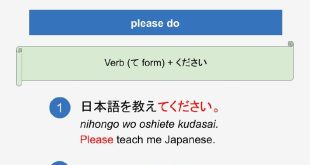
14. ~てください
15. ~てもいいです
16. ~てはいけません
17. ~から
18. ~ている
19. ~にいく
20. ないでください
21. ~のがすきです
22. ~のがじょうずです
23. ~のがへたです
24. まだ~ていません
25. ~のほうが~より
26. ~のなかで~がいちばん~
27. つもりです
28. ~く/ ~になる
29. V stem + たいです
30. ~たり …~たりする
31. ~たことがある
32. や
33. ~んです
34. ~すぎる
35. ~ほうがいい
36. ので
37. ~なくちゃいけない
38. でしょう
39. ~まえに
40. ~てから
1. です
This means “is”, “am”, or “are” (depending on the situation), though the meaning in English is a lot broader than in Japanese. Some other words (「いる」 and 「ある」) also mean “is”, depending on the situation.
Example:
わたしは マイクです。
I am Mike.
これは ペンです。
This is a pen.
2. も
This means “too”, “and”, or “also”.
Example:
かれは サッカーが すきです。わたしも サッカーが すきです。
He likes soccer. I like soccer, too.
ケンは ケーキも クッキーも 食べました。
(ケンは ケーキも クッキーも たべました。)
Ken ate both cake and cookies.
3. で
This means “at” or “in”, and is used when specifying where something happens.
Example:
エミは 学校で 数学を 勉強します。
(エミは がっこうで すうがくを べんきょうします。)
Emi studies math at school.
4. に/へ
This means “to” and indicates such things as location of person or thing, location of short-term action, etc , and is used when describing a destination.
Example:
リエ子は ローマに 行きました。
(リエこは ローマに いきました。)
Rieko went to Rome.
5. に
This is a general use preposition. It can mean “in”, “at”, “to”, “for”, and other general prepositional phrases, depending on the context.
Example:
この本を あの人に あげてください。
(このほんを あのひとに あげてください。)
Please give the book to that person.
冬に、雪が 降ります。
(ふゆに、ゆきが ふります。)
In winter, it snows.
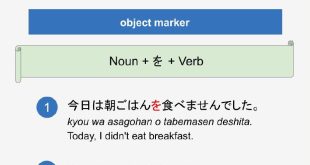
6. を
This denotes the object of an action.
Example:
あの猫は魚を食べた。
(あのねこはさかなをたべた。)
That cat ate the fish.
7. ~ませんか
This means “Won’t you ~ ?” or “Shall we ~ ?”. It’s an invitation.
Example:
ケーキをたべませんか?
Won’t you have some cake?
えいがをみませんか?
Won’t you (shall we) watch a movie?
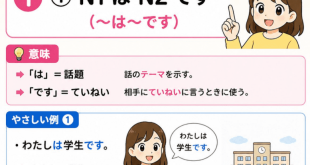
8. は
This denotes a topic.
Example:
彼女は嬉しいです。
(かのじょはうれしいです。)
She is happy.
9. ~があります
This means “there is”. It is used for non-living things (use 「がいます」 for living things).
Example:
つくえの上に ボールが あります。
(つくえのうえに ボールが あります。)
There is a ball on the desk.
はこの中に プレゼントが ありますか。
(はこのなかに プレゼントが ありますか。)
Is there a present in the box?
10. ~がいます
This means “there is” or “is” and is used for living things.
Example:
あそこの木の下に、二人の 子どもがいます。
(あそこのきのしたに、ふたりの こどもがいます。)
There are two children under the tree over there.
きょうしつに田中先生がいますか。
(きょうしつにたなかせんせいがいますか。)
Is Mr. Tanaka in the classroom?
11. と
This is a particle used to link nouns in a complete list.
Example:
そのサラダはレタスと にんじんと ラディッシュから 作りました。
(そのサラダはレタスと にんじんと ラディッシュから つくりました。)
The salad was made from lettuce, carrot, and radish.
12. ~ましょう
This is a polite volitional phrase, meaning “I’ll” or “let’s”.
Example:
食べましょう。
(たべましょう。)
Let’s eat!
13. ~ましょうか
This is a polite volitional phrase used for suggestions.
Example:
食べましょうか。
(たべましょうか。)
How about we eat?
14. ~てください
This is used to link verb copulas, ending in “て” or “で”, to “ください”, making it into a request.
Example:
日本語ではなしてください。
(にほんごではなしてください。)
Please speak in Japanese.
彼にいってください。
(かれにいってください。)
Please tell it to him.
15. ~てもいいです
This is used to link verb copulas to “もいいです” meaning “it’s enough” or “it’s good”. It can be used as a request for permission.
Example:
料理してもいいですか。
(りょうりしてもいいですか。)
May I cook?
食べてもいいです。
(たべてもいいです。)
You may eat.
16. ~てはいけません
This is used to link copulas to “はいけません”, meaning “it’s not good”. It is used to scold or otherwise disapprove.
Example:
サーラーの 手書きは よくありません。
(サーラーの てがきは よくありません。)
Sarah’s handwriting is not great yet.
“はいけません”, meaning “No you must not…” This is formed by using the te-form.
て-form + はいけません…
Example:
ここに 車を停めてはいけません。
(ここに くるまを とめてはいけません。)
You must not park the car here.
17. ~から
Phrase meaning “from”.
Example:
この電車はサンホセから サンフランシスコにいきます。
(このでんしゃはサンホセから サンフランシスコにいきます。)
This train goes from San Jose to San Francisco.
18. ~ている
いる, when used after the て form of a verb, indicates that an action is ongoing (progressive tense, marked in English by “ing”,) or in a certain state.
Example:
私は 読んでいます。
(わたしは よんでいます。)
I am reading.
ドアが 開いています。
(ドアが あいています。)
The door is open.
僕は 結婚しています。
(ぼくは けっこんしています。)
I am married.
子供は 走っています。
(こどもは はしっています。)
The children are running.
19. ~にいく
It means to go somewhere or to go do something. If meaning to go do something, the にいく is used after a stem (a verb in its ます form without the ます, for example: the stem of 書き(かき)ます is 書き).
Example:
私は泳ぎに行く。
(わたしはおよぎにいく。)
I go swimming.
彼は勉強に行った。
(かれはべんきょうにいった。)
He went to study.
彼女は東京に行く。
(かのじょはとうきょうにいく。)
She’s going to Tokyo.
20. ないでください
This means “please don’t do”, used in place of a ない form of a verb.
Example:
このりんごを食べないでください。
(このりんごをたべないでください。)
Please don’t eat this apple.
その本を読まないでください。
(そのほんをよまないでください。)
Please don’t read that book.
21. ~のがすきです**
It means to like doing something.
Example:
私はアニメを見るのが好きです。
(わたしはアニメをみるのがすきです。)
I like watching anime.
彼女は歌うのが好きです。
(かのじょはうたうのがすきです。)
She likes singing.
22. ~のがじょうずです
It means to be good at something.
Example:
彼女は歌うのが上手です。
(かのじょはうたうのがじょうずです。)
She’s good at singing.
あなたは泳ぐのが上手ですか。
(あなたはおよぐのがじょうずですか。)
Are you good at swimming?
23. ~のがへたです
It means to be bad at something.
Example:
私は踊るのが下手です。
(わたしはおどるのがへたです。)
I’m bad at dancing.
彼は勉強するのが下手です。
(かれはべんきょうするのがへたです。)
He’s bad at studying.
24. まだ~ていません
It means that someone hasn’t done something yet.
Example:
私は まだ 決めていません。
(わたしは まだ きめていません。)
I haven’t decided yet.
彼は まだ 帰っていません。
(かれは まだ かえっていません。)
He hasn’t returned yet.
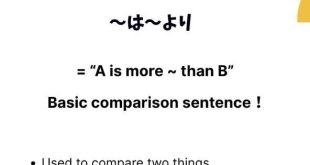
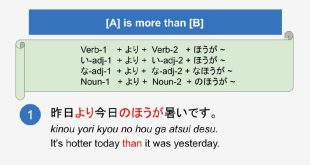
25. ~のほうが~より
It means that something is more (interesting/expensive/etc.) than something else.
Example:
この本のほうが あの新聞より 高い。
(このほんのほうが あのしんぶんより たかい。)
This book is more expensive than that newspaper.
図書館の方が 学校より 静か。
(としょかんのほうが がっこうより しずか。)
Library is quieter than school.
26. ~のなかで~がいちばん~
It means the best from something or the most (new/old/expensive/likeable/etc.).
Example:
あの図書館の中で この本がいちばん。
(あのとしょかんのなかで このほんがいちばん。)
This book is the best book in that library.
このお菓子の中で クッキーがいちばん好きです。
(このおかしのなかで クッキーがいちばんすきです。)
From these sweets I like cookies the most.
27. つもりです
This means a plan or an intent of doing something.
Example:
私は 映画を 見に行くつもりです。
(わたしは えいがを みにいくつもりです。)
I’m going to go see a movie.
あなたは 何を勉強するつもりですか?
(あなたは なにをべんきょうするつもりですか?)
What are you going to study?
28. ~く/ ~になる
It means to become (smart/tall/etc.). If used with -na adjectives it’s adj+になる, for -i adjectives it’s adj+くなる.
Example:
あの女性は きれいになった。
(あのじょせいは きれいになった。)
That woman became beautiful.
この自転車は 古くなった。
(このじてんしゃは ふるくなった。)
This bicycle became old.
29. V stem + たいです**
Creates the polite ‘want to do’ form of a verb
Example
僕はケーキを食べたいです。
(ぼくはケーキをたべたいです。)
I want to eat some cake.
30. ~たり …~たりする
It makes a list of activities or attributes. It means something like “this and that/sometimes this and sometimes that/in some parts this in other parts that”. With nouns or -na adjectives it becomes “~だったり …~だったりする”.
Example:
昨日 私は本を読んだり お菓子を食べたりした。
(きのう わたしはほんをよんだり おかしをたべたりした。)
Yesterday I was reading a book and eating sweets.
あの映画は 面白かったり つまらなかったりする。
(あのえいがは おもしろかったり つまらなかったりする。)
That movie is interesting in some parts and boring in other parts.
彼女は 親切だったり きれいだったりする。
(かのじょは しんせつだったり きれいだったりする。)
She’s nice and beautiful.
31. ~たことがある
It indicates that something has (or hasn’t ever) happened in the past.
Example:
私は東京へ行ったことがある。
(わたしはとうきょうへいったことがある。)
I’ve been to Tokyo.
私はそれを聞いたことがない。
(わたしはそれをきいたことがない。)
I’ve never heard of this.
32. や
This is a particle used to link nouns in an incomplete list.
Example:
猫や 犬や 猿が 動物園にいます。
(ねこや いぬや さるが どうぶつえんにいます。)
There are cats and dogs and monkeys (among other things) at the zoo.
33. ~んです
It accents the sentence’s content or softens a request or an order. It may be also said as “~のです”. With -na adjectives and nouns it becomes “~なのです”.
Example:
私は 今 忙しいんです。
(わたしは いま いそがしいんです。)
I’m busy right now.
私は 今 そうじ中なのです。
(わたしは いま そうじちゅうなのです。)
I’m cleaning right now.
テニスはするんですか?
Do you play tennis? (at all, not right now)
34. ~すぎる
It means “too much” or “too (big/small/expensive/etc.)”.
Example:
山田さんは食べすぎる。
(やまださんはたべすぎる。)
Mr. Yamada eats too much.
私は食べ物を買いすぎた。
(わたしはたべものをかいすぎた。)
I bought too much food.
このシャツは大きすぎる。
(このシャツはおおきすぎる。)
This shirt is too big.
35. ~ほうがいい
It means “it’s better” or “it would be better”, it may be also used to say that something should (or shouldn’t) be done.
Example:
あなたはこの本を買ったほうがいい。
(あなたはこのほんをかったほうがいい。)
You should buy this book.
私はあのケーキを食べないほうがいい。
(わたしはあのケーキをたべないほうがいい。)
I shouldn’t eat that cake.
36. ので
It means “because” or “so”. The cause is more impartial (like because a building is red or tall) than with “から” or “だから” where it’s more subjective (like because you think an apple tastes good). With nouns and -na adjectives it becomes “なので”.
Example:
この本は高いので買わない。
(このほんはたかいのでかわない。)
I’m not buying this book, because it’s expensive.
あの映画を見たので 他の映画を見よう。
(あのえいがをみたので ほかのえいがをみよう。)
I’ve seen this movie so let’s watch a different one.
彼女は病気なので来ない。
(かのじょはびょうきなのでこない。)
She isn’t coming because she’s sick.
37. ~なくちゃいけない
It means that something has to be done (lit: it’s bad not to do it).
Example:
あなたは宿題を終わらなくちゃいけない。
(あなたはしゅくだいをおわらなくちゃいけない。)
You have to finish your homework.
38. でしょう
It means something like “isn’t it/aren’t you/aren’t I/etc.” or “right?”. It’s used when the speaker isn’t sure about something or in rhetorical questions.
Example:
あなたは七時まえに 帰るでしょ?
(あなたはしちじまえに かえるでしょ?)
You’ll come back before 7 o’clock, right?
これは本でしょ?
(これはほんでしょ?)
It’s a book, isn’t it?
あのビルは普通じゃないでしょ?
(あのビルはふつうじゃないでしょ?)
That building isn’t normal, is it?
彼は泳げないでしょ?
(かれはおよげないでしょ?)
He can’t swim, can he?
ドレスは黒くて青いでしょ?
(ドレスはくろくてあおいでしょ?)
The dress is black and blue, isn’t it?
39. ~まえに
It means “before doing (something)” or “ago” (like 3 days ago).
Example:
食べる前に手を洗って下さい。
(たべるまえにてをあらってください。)
Please wash your hands before eating.
私は一時間前に帰った。
(わたしはいちじかんまえにかえった。)
I came back an hour ago.
私はプールで入る前に 30 分も待ちました。
(わたしはプールではいるまえにさんじゅっぷんもまちました。)
I waited 30 minutes before entering the pool.
40. ~てから
It means to do something after doing something else.
Example:
考えてから 言ってください。
(かんがえてから いってください。)
Please speak after thinking.
私は 手を洗ってから 食事をした。
(わたしは てをあらってから しょくじをした。)
I had a meal after washing my hands.
私は 宿題をしてからねました。
(わたしは しゅくだいをしてからねました。)
I went to sleep after doing homework.
…
Related Post:
Japanese Grammar for JLPT N5 PDF
JLPT N5 Grammar Study Guide